Plants and Animals Live Together Class 3 Question Answer EVS Chapter 5
Click here to access the best NCERT Solutions EVS Class 3 Question Answer Our Wondrous World Unit 2 Life Around Us Chapter 5 Plants and Animals Live Together textbook exercise questions and answers.
EVS Class 3 Chapter 5 Questions and Answers Plants and Animals Live Together
Plants and Animals Live Together Class 3 EVS Question Answer
Discuss (Page 64)
Question 1.
Which of the animals shown on page 63, have you seen before? Describe where and how you saw them. Use your fingers, hands, and arms to show how small or big these animals are!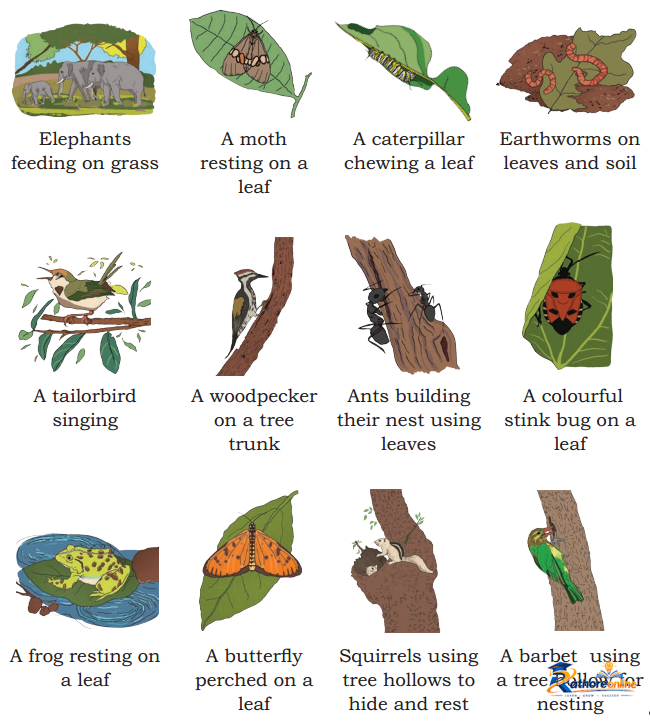
Answer:
Hint: Several animals are shown on page 63 such as elephants, moths, caterpillars, earthworms, tailorbirds, woodpeckers, ants, bugs, frogs, butterflies, squirrels, barbet, etc. From the above given animals recall the animals that you have seen before. Also, describe whether you saw them in your immediate surroundings or a zoo.
- Earthworms, moths, caterpillars, butterflies, squirrels, ants, bugs, and frogs are small animals whose size can be shown with the help of fingers.
- Elephants are big animals and their size can be shown with the help of arms.
- Woodpeckers, tailorbirds, and barbets can be shown with the help of your hands as they are medium-sized animals.
Find Out (Page 64)
Question 1.
Why do these animals choose to live near plants?
Answer:
These animals are dependent on plants for their survival. They get food, shelter, protection, etc., from plants.

Page 64
Question 1.
What color is the soil under your feet?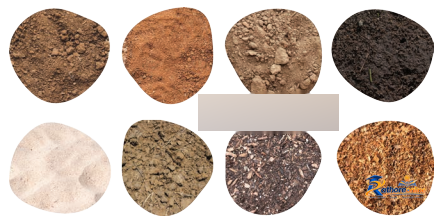
Answer:
Hint: From the above options the type of soil below my feet is as given below:
Observe your immediate surroundings and find the type of soil present there.
Activity 1 (Page 64)
Pick up a little soil near your plant friend with your hands.
- How does it look and feel?
- Is it dry, damp, rough, smooth, hard, or grainy?
- Did you find any leaves or insects in the soil?
- Now smell this soil and remember it.

Answer:
Hint: After picking up a soil sample near my plant friend, the following features could be felt:
Page 65
Question 1.
Examine the soil more carefully. What small things do you notice in it?
Answer:
Hint: After scrutinizing the soil, I noticed small stones, grasses, leaves, beetles, twigs, leaves, etc.

Discuss (Page 66)
Question 1.
In the monsoons, you may find many more plants and animals around. Where did these new plants and animals come from? Why could you not see them earlier?
Answer:
Monsoons provide essential moisture that helps in the germination of dormant seeds and promotes rapid plant growth. These seeds remain dormant and suddenly sprout when conditions become favorable with increased rainfall. New plants and animals originate from seeds, eggs, or dormant stages of life cycles due to increased rainfall and the favorable conditions it brings. They may not have been as visible or active earlier due to the dry conditions.
Activity 2 (Page 66)
Stand near your plant friend and look around. How many different animals can you spot? Describe them in words and fill in the table. You may use the given pictures if needed.
Answer:
Hint: The table has been filled for your reference. You can also fill it with your own experience.
| I saw… (Describe) | It was on… | What was it doing? |
| A small hopping insect | The grass | Jumping around |
| A thin plant that curls | Another plant nearby | Nothing |
| A blackbird | Tree | Singing |
| A butterfly | The flower | Collecting nectar |
| An earthworm | The heap of soil | Eating soil |
Page 68
Question 1.
How many of these animals have you seen? Watch out for them!
Answer:
Hint: Crows, squirrels, monkeys, etc., are the animals that can be seen easily near our immediate surroundings.
You can observe your plant friend and surroundings and make a list of animals that you saw.
Activity 3 (Pages 68-69)
Sounds of Birds
- Close your eyes and try to listen to listen to the sounds of birds.
Do you hear any bird sounds?
Can you see which birds are making these sounds?
- Cup your ears with your hands as shown in the picture and point your face towards the direction of the bird sound. Can you hear the sound more clearly?

Different birds, Different sounds
- Recall the bird sounds you have listened to. Try to produce the sounds that different birds make.
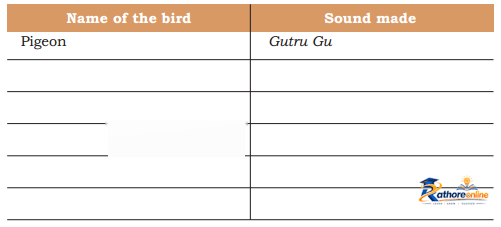
- Now try to write down in the following table the sound of any birds you have heard.
- If you do not hear any sounds of birds, what do you think is the reason?
- Do you hear more bird sounds:
- In the early morning?
- In the afternoon?
- In the evening?

Answer:
Hint: One morning I was walking in my nearest park and I heard different birds making different sounds. I closed my eyes and felt the sound clearer.
You can also do the same and cup your ears with your hands to hear the sounds of birds chirping.
You can also recall the bird sounds you have listened to during your visit to the nearest park and try to produce the sounds that different birds were making.
| Name of the Bird | Sound Made |
| Cock | Cukroo coo |
| Cuckoo | Coo coo |
| Crow | Caw caw |
| Sparrow | Chi chi |
| Peacock | Maow Maow |
- The absence of bird sounds could be due to several reasons such as time of the day, seasonal factors (extreme hot or cold or heavy rainfall), human disturbances, etc.
- Birds are often most vocal during the early morning and in the evening. They are resting or less active during other times of the day.

Let us reflect (Pages 70-71)
A. Discuss
Question 1.
What was the color and texture of the two soil specimens that you collected during the previous activity? In which month did you pick them up? Did they smell different and can you describe the smells?
Answer:
Hint: The answer is given to you in tabular form. You can also write it with the help of your parents and teacher.
| Features | Soil Specimen 1 | Soil Specimen 2 |
| Soil Colour | Black | Brownish |
| Soil Texture | Rough | Grainy |
| Month | May | July |
| Smell | Dusty | Petrichor |
Question 2.
During which month did fresh new leaves appear on the plant that you were observing?
Answer:
The arrival of fresh leaves can be seen in both spring (Basil, Rose) and monsoon (Hibiscus, Lily) seasons.
Question 3.
Which animals, birds, and insects did you notice around plants?
Answer:
Hint: The following could be noticed around plants:
- Animals: Squirrel, Monkey, Rabbit
- Birds: Sparrow, Parrot, Cuckoo
- Insects: Grasshopper, Beetle, Butterfly
Question 4.
Recall and write about how animals, birds, and insects rely on plants. Which one was your favorite example?
Answer:
Animals, birds, and insects are dependent on plants for their survival. They get food, shelter, protection, etc., from plants.
Hint: The rabbit was my favorite animal. (Do it Yourself.)
Question 5.
What is soil made up of?
Answer:
Soil is made from large rocks that have broken up into tiny pieces. It is also composed of old leaves, roots, stems, and living and dead animals like insects.
B. Write
Answer:
| Name two animals that you observed near or on plants. | Butterfly | Monkey |
| Describe the shape, size, and colors of these animals. | Shape and size vary according to the species Colour-vibrant | Shape and size vary Colour-Usually brown |
| Guess why these animals were staying near these plants. | To collect nectar | For eating fruits |
| What other interesting things did you notice about these animals? | Their beauty and diversity make them different from other | Prehensile tails used for grasping branches |
C. Draw
Question 1.
Remember you wrote about your plant friend. Now try and draw your plant friend. Use different colored small dots in your drawing to show the places where you spotted animals, birds, or insects.
Answer:
Hint: Recall your plant friend and do it yourself with the help of your teacher and parents.

D. Put in order
Question 1.
One day Suma found a caterpillar on a tagar plant. She found it interesting. She observed it for about 10 minutes. It was eating tender leaves continuously. Her mother came close to her. She guided her to observe the caterpillar each day. Suma became more curious. Consult an elder person and organize the following changes in order. Now it was a butterfly.
 The caterpillar formed a cocoon.
 It flew away gently.
 One day it stopped eating.
 It came out of the cocoon.
Answer:
Hint: The given life cycle of the butterfly has been filled out for your reference. Now it was a butterfly:
 The caterpillar formed a cocoon.
 It flew away gently.
 One day it stopped eating.
 It came out of the cocoon.